Aseptic Tomato Paste: 9 Powerful Benefits for Bulk Buyers
Aseptic Tomato Paste is a key industrial ingredient for food manufacturers, ketchup producers, sauce factories, importers, distributors, and private-label food companies looking for a concentrated tomato solution suitable for large-scale production.
This B2B guide explains the essential factors buyers should understand before sourcing bulk aseptic tomato paste, including 28–30 Brix and 36–38 Brix specifications, Hot Break and Cold Break processing, industrial drum packaging, applications, quality considerations, and supplier selection.
Aseptic tomato paste is a concentrated tomato product that undergoes controlled processing and is filled into sterile packaging under aseptic conditions. It is commonly supplied in industrial drums and used by manufacturers to produce ketchup, sauces, soups, ready meals, condiments, and other tomato-based foods.
Why Is Aseptic Tomato Paste Important for Global Food Manufacturing?
Tomatoes are naturally perishable agricultural products. Their quality, availability, and characteristics can change according to variety, harvest period, growing conditions, and geographical origin.
Industrial food manufacturers, however, often require tomato ingredients throughout the year. This creates a need for concentrated products that can be efficiently stored, transported, and incorporated into standardized production processes.
Aseptic tomato paste provides manufacturers with a concentrated source of tomato solids. By removing part of the naturally occurring water during processing, tomato processors create a product that is much more concentrated than fresh tomato juice.
The combination of concentration and industrial aseptic packaging makes the product particularly relevant to international B2B supply chains.
Manufacturers can use tomato paste as a base ingredient and adjust water, salt, sugar, spices, and other ingredients according to the formulation of their finished product.
9 Powerful Benefits of Aseptic Tomato Paste for Bulk Buyers
1. Efficient Ingredient for Industrial Production
Industrial food factories require ingredients that can be integrated efficiently into large-scale production systems. Concentrated tomato paste allows manufacturers to work with tomato solids without processing large quantities of fresh tomatoes for every production cycle.
This can simplify ingredient handling and formulation while giving food technologists greater control over the final recipe.
2. Suitable for Large-Volume B2B Supply
Aseptic tomato paste is commonly traded as an industrial food ingredient rather than a retail product.
Bulk packaging makes it suitable for factories, importers, distributors, foodservice suppliers, and private-label manufacturers purchasing commercial quantities.
3. Practical for International Transportation
Concentrating tomatoes removes a significant amount of water from the original tomato material. This makes concentrated tomato products particularly practical for industrial logistics.
Drums can also be palletized and arranged for container transportation, helping international buyers plan shipments and warehouse requirements.
4. Multiple Brix Options for Different Applications
Professional buyers can source different concentration ranges depending on the intended application.
Two specifications frequently discussed in the international tomato paste market are 28–30 Brix and 36–38 Brix.
The appropriate concentration depends on the buyer's formulation, processing equipment, target product characteristics, and commercial requirements.
5. Suitable for a Wide Range of Food Products
Aseptic tomato paste can serve as a tomato base for numerous industrial food applications.
Typical uses include ketchup, pizza sauce, pasta sauce, cooking sauces, soups, ready meals, canned products, marinades, condiments, and selected tomato-based beverages.
6. Different Processing Options
Industrial buyers may encounter both Hot Break and Cold Break tomato paste.
These processing approaches can influence characteristics such as consistency and viscosity, making product selection important for specific food formulations.
7. Industrial Packaging Designed for Bulk Handling
Aseptic bags placed inside protective drums are widely used for industrial tomato paste.
This type of packaging is designed around the needs of commercial handling, storage, transportation, and manufacturing operations.
8. Easier Production Planning
Defined product specifications and industrial packaging can help procurement teams estimate ingredient requirements, warehouse capacity, production consumption, and shipment quantities.
9. Flexible Ingredient for Different Formulations
Food manufacturers can use concentrated tomato paste as a base and adapt the final formulation according to their product requirements.
For this reason, the same general ingredient category can serve several segments of the food industry, provided that the technical specification matches the intended application.
28–30 Brix vs. 36–38 Brix Aseptic Tomato Paste
Brix is one of the first specifications industrial buyers encounter when sourcing tomato paste.
In practical procurement terms, Brix provides an indication of the concentration of soluble solids in the tomato product.
| Specification | 28–30 Brix | 36–38 Brix |
|---|---|---|
| Concentration | Lower concentration | Higher concentration |
| Industrial Use | Suitable for formulations requiring this concentration range | Suitable where a more concentrated tomato ingredient is required |
| Selection | Based on formulation and production requirements | Based on formulation, dilution and processing requirements |
| Buyer Evaluation | Brix should be considered together with consistency, color, acidity, processing method, quality specifications and cost. | |
A common purchasing mistake is assuming that a higher Brix automatically means a better tomato paste.
That is not necessarily the case.
The correct specification is the one that performs appropriately in the buyer's production process while meeting technical and commercial requirements.
What Is 28–30 Brix Tomato Paste?
28–30 Brix tomato paste is a concentrated tomato product within a commonly encountered industrial concentration range.
Manufacturers may select this specification when its concentration, consistency, processing characteristics, and economics fit the target finished product.
Before purchasing, buyers should request the complete technical specification instead of relying exclusively on the Brix value.
What Is 36–38 Brix Tomato Paste?
36–38 Brix tomato paste has a higher soluble-solids concentration than 28–30 Brix paste.
For some manufacturers and importers, transporting a more concentrated product can offer formulation or logistical advantages.
However, the commercial decision should consider the total cost of using the ingredient rather than simply comparing the purchase price per drum.
Factors such as yield, dilution requirements, freight, production performance, and final-product specifications should be considered.
Hot Break vs. Cold Break Tomato Paste
Another important technical consideration when sourcing Aseptic Tomato Paste is the processing method.
Hot Break Tomato Paste
Hot Break processing generally involves relatively higher temperatures during an early stage of tomato processing.
This processing approach can influence enzyme activity and the consistency characteristics of the resulting tomato paste.
Depending on the required specification, Hot Break tomato paste may be considered for applications such as ketchup and thicker tomato-based sauces.
Cold Break Tomato Paste
Cold Break processing uses a different temperature profile and can produce different viscosity and sensory characteristics.
It may be considered for selected sauces, soups, tomato-based beverages, and other applications requiring different flow characteristics.
Neither method should automatically be described as universally superior. The right option depends on the manufacturer's formulation and desired finished-product characteristics.
Aseptic Tomato Paste in Drums: Why Industrial Buyers Use Bulk Packaging
Retail jars and cans are generally inefficient for a factory consuming large quantities of tomato ingredients.
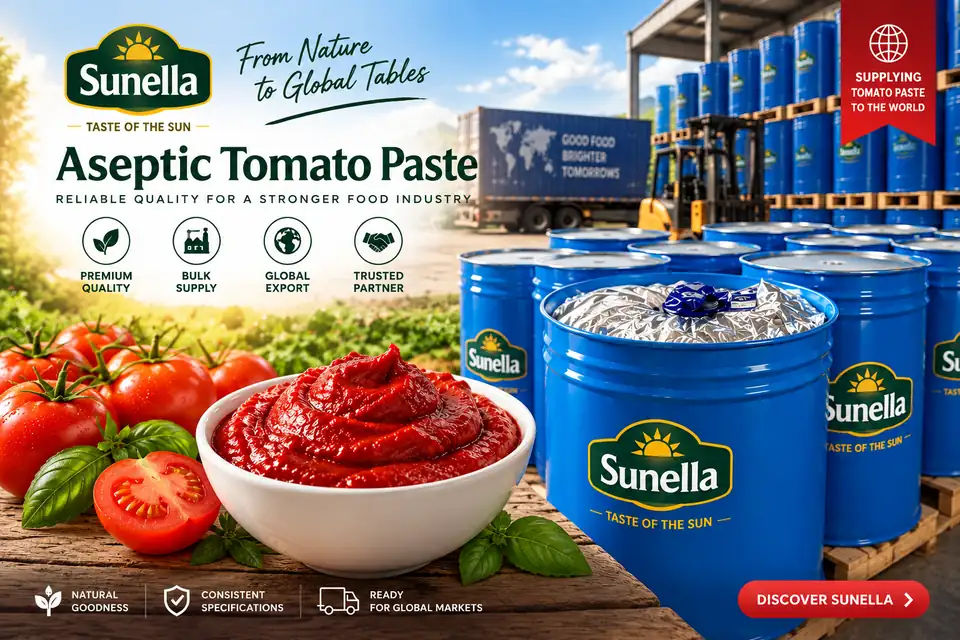
For industrial supply, tomato paste is commonly filled into an aseptic bag that is placed inside a protective drum.
This packaging format can provide several practical advantages for B2B buyers, including easier bulk handling, warehouse organization, palletization, and international container transportation.
Do not assume that every supplier offers the same drum weight or container-loading configuration. Before ordering, confirm the net weight, gross weight, aseptic bag specification, pallet configuration, number of drums, and container-loading details with the supplier.
Who Buys Bulk Aseptic Tomato Paste?
The target market for industrial tomato paste extends across several segments of the global food industry.
Ketchup Manufacturers
Tomato paste is an important tomato ingredient in many ketchup formulations. Manufacturers select specifications according to their recipe, consistency requirements, and processing system.
Pizza and Pasta Sauce Manufacturers
Sauce producers can use concentrated tomato paste as a base before incorporating water, seasonings, herbs, oil, vegetables, or other ingredients.
Ready-Meal Manufacturers
Tomato paste can be incorporated into industrial recipes for prepared meals, cooking sauces, soups, and other convenience foods.
Importers and Distributors
Food ingredient importers may purchase commercial quantities for distribution to manufacturers within their target markets.
Private-Label Food Producers
Contract and private-label manufacturers often require repeatable ingredient specifications to support consistent production across multiple batches.
How to Choose an Aseptic Tomato Paste Supplier
Finding a supplier is easy. Selecting a supplier that fits your technical, commercial, and logistical requirements requires a more structured procurement process.
Instead of comparing only price quotations, professional buyers should evaluate the complete supply proposal.
Check the Technical Specification
Ask for a detailed product specification covering the parameters relevant to your application.
Depending on your requirements, these may include Brix, pH, acidity, color, consistency, microbiological parameters, processing type, ingredients, and packaging.
Request Quality Documentation
Professional buyers commonly request a Certificate of Analysis or comparable documentation for commercial food ingredients.
The exact documentation required depends on the buyer, product, destination country, and applicable regulatory requirements.
Evaluate Traceability
Ask how production lots are identified and what batch-related documentation can be provided.
Confirm Packaging
Verify net weight, drum construction, aseptic bag configuration, palletization, and loading quantities before calculating your landed cost.
Review Logistics Capability
International sourcing also involves shipment planning, container loading, export documentation, and coordination with logistics providers.
These factors can be just as important as the factory price of the product.
What Quality Factors Should Tomato Paste Buyers Check?
Brix is important, but it should never be the only purchasing criterion.
Depending on the intended application, a professional evaluation may consider:
- Brix and soluble-solids concentration
- Color characteristics
- Consistency or viscosity
- pH
- Acidity
- Flavor profile
- Microbiological specifications
- Processing method
- Packaging integrity
- Production date
- Shelf-life information
- Batch identification and traceability
- Required certificates and documentation
Two products with a similar Brix range can still behave differently during manufacturing. This is why technical evaluation and, where appropriate, product testing are important before establishing long-term supply.
How to Request a Quote for Bulk Aseptic Tomato Paste
A clear Request for Quotation can save time for both buyer and supplier. Instead of asking only for a price, provide enough information for the supplier to understand your requirement.
A useful B2B tomato paste RFQ can include:
- Product required: Aseptic Tomato Paste
- Required Brix range
- Hot Break or Cold Break preference, if required
- Required packaging format
- Estimated order quantity
- Destination country
- Destination port
- Preferred Incoterm
- Required certificates and documents
- Target shipment period
- Any application-specific technical requirements
Providing detailed purchasing information allows suppliers to respond with a more relevant commercial proposal.
Frequently Asked Questions About Aseptic Tomato Paste
What is Aseptic Tomato Paste?
Aseptic tomato paste is concentrated tomato product that has undergone controlled processing and is filled into sterile packaging under aseptic conditions. It is primarily used as an industrial ingredient in tomato-based food production.
What is Aseptic Tomato Paste used for?
It is commonly used to manufacture ketchup, pizza sauce, pasta sauce, soups, cooking sauces, ready meals, condiments, canned foods, and other tomato-based products.
What is the difference between 28–30 and 36–38 Brix tomato paste?
The primary difference is concentration. A 36–38 Brix product contains a higher concentration of soluble solids than a 28–30 Brix product. The appropriate option depends on the buyer's formulation and manufacturing requirements.
Is 36–38 Brix tomato paste better than 28–30 Brix?
Not necessarily. Higher concentration does not automatically mean better performance. Buyers should choose a specification based on their recipe, processing system, desired product characteristics, and commercial economics.
What is the difference between Hot Break and Cold Break tomato paste?
The terms refer to different processing conditions, particularly during the early thermal processing stage. These differences can influence characteristics such as consistency and viscosity.
How is bulk Aseptic Tomato Paste packaged?
Industrial aseptic tomato paste is commonly filled into aseptic bags placed inside protective drums. Exact drum sizes and loading configurations vary between suppliers and contracts.
What should I ask a tomato paste supplier before buying?
Ask for the technical specification, Brix range, processing type, quality parameters, packaging details, production and shelf-life information, traceability, required certificates, commercial terms, and shipment details.
Can Aseptic Tomato Paste be used for ketchup production?
Yes. Tomato paste is widely used as a tomato ingredient in ketchup manufacturing. The required specification should be selected according to the manufacturer's recipe and consistency requirements.
A Smarter Approach to Bulk Tomato Paste Sourcing
The best sourcing decision is not necessarily the product with the highest Brix or the lowest quoted price.
For professional food manufacturers and importers, the goal is to identify a tomato ingredient that matches the required technical specification while also meeting commercial, packaging, documentation, and logistical requirements.
Evaluating these factors together can help procurement teams make better-informed sourcing decisions and establish more efficient long-term supply relationships.
Looking for Tomato Products for Your Business?
If you are an importer, distributor, food manufacturer, ketchup producer, sauce manufacturer, or other B2B buyer, you can explore current product and commercial information through Sunella Food.
When making an inquiry, include your required product specification, quantity, destination, packaging requirements, and target shipment period to support a more efficient B2B discussion.
Visit Sunella FoodConclusion
Aseptic Tomato Paste is an important concentrated ingredient for modern industrial food production and international tomato-product supply chains.
For bulk buyers, understanding Brix, Hot Break and Cold Break processing, industrial drum packaging, quality specifications, traceability, and logistics is essential before making a purchasing decision.
Rather than choosing tomato paste on a single specification, professional buyers should evaluate how the complete product profile fits their manufacturing requirements.
A well-defined specification and detailed RFQ can also make communication between buyers and suppliers more efficient, helping both sides identify the appropriate product and commercial conditions for a potential business relationship.