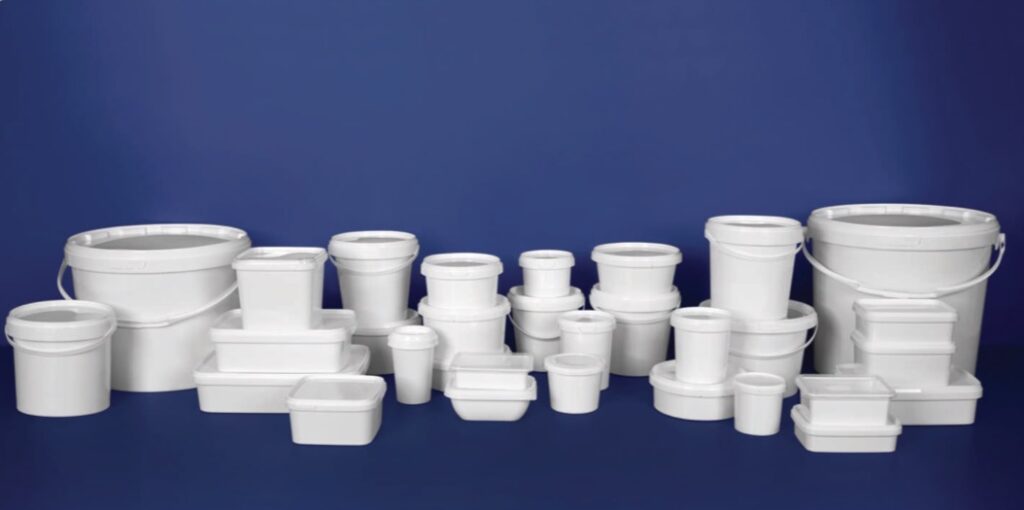
A Durable, Hygienic, and Export-Ready Solution for Professional Food Businesses
Introduction:
In today’s competitive food supply chains, packaging is no longer just a container—it is a critical factor in food safety, operational efficiency, brand perception, and export compliance. For HORECA (Hotels, Restaurants, Cafes) and B2B food buyers, packaging must perform under pressure: frequent handling, cold chains, moisture exposure, stacking, and long-distance transportation.
This is where IML (In-Mold Labeling) packaging has become a preferred solution for professional food businesses serving domestic and international markets.
⸻
What Is IML Packaging?
In-Mold Labeling (IML) is an advanced packaging technology in which a pre-printed label is placed inside the mold during the injection molding process. As the container is formed, the label becomes an integral part of the packaging itself—not glued, not applied afterward, and not removable.
This results in:
• A single, unified structure (container + label)
• No adhesives
• A smooth, high-quality surface
• Exceptional durability and hygiene
⸻
Why IML Matters for HORECA and B2B Buyers
HORECA and B2B buyers prioritize consistency, hygiene, logistics efficiency, and regulatory compliance. Unlike retail consumers, professional buyers look beyond aesthetics—they focus on performance and reliability.
IML packaging addresses these priorities directly by offering:
• Resistance to moisture, oils, and temperature changes
• Long shelf life without label degradation
• Clean presentation even after repeated handling
• Stackability and transport efficiency
⸻
Hygiene and Food Safety Advantages
Food safety standards in GCC, CIS, and international hospitality markets are increasingly strict. IML packaging supports compliance by design:
• No glue or adhesive layers, reducing contamination risk
• Smooth, sealed surfaces that are easy to clean
• Resistant to peeling, bubbling, or cracking
• Suitable for chilled, frozen, and ambient products
For professional kitchens and catering operations, this means less risk, less waste, and higher operational confidence.
⸻
Durability Under Professional Use
In HORECA environments, packaging is exposed to:
• Cold rooms and freezers
• Humidity and condensation
• Frequent opening and closing
• Stacking in storage and transport
IML containers maintain:
• Label integrity
• Structural strength
• Visual consistency
Even after long storage or transport, the packaging looks clean and professional, which is critical for B2B food service and export shipments.
⸻
IML and Export-Ready Packaging
For exporters supplying hotels, airlines, caterers, distributors, and food service operators, packaging must survive long supply chains.
IML packaging supports export by:
• Withstanding temperature fluctuations
• Remaining legible and intact throughout logistics
• Meeting international hygiene expectations
• Enhancing perceived product quality in foreign markets
This makes IML ideal for GCC and CIS food distribution, where visual quality and durability are equally important.
⸻
Operational Efficiency for B2B Supply Chains
From filling lines to warehouses and kitchens, IML packaging improves efficiency:
• No label application stage (time-saving)
• Reduced packaging failures
• Better stackability and space optimization
• Faster handling in professional environments
For B2B buyers, this translates into lower operational friction and predictable performance.
⸻
Applications of IML in HORECA and B2B
IML is widely used across food service categories, including:
• Dairy products (yogurt, cream, butter)
• Sauces, dips, and condiments
• Ready-to-eat meals
• Frozen foods and IQF products
• Catering portions and bulk food containers
Its versatility makes it suitable for central kitchens, catering companies, hotels, and distributors.
⸻
Sustainability and Environmental Considerations
IML packaging contributes to sustainability goals by:
• Using mono-material structures (easier recycling)
• Eliminating adhesive waste
• Reducing label separation during recycling
For B2B buyers and hospitality groups focused on environmental responsibility, this is an added advantage.
⸻
IML vs Traditional Labeling (B2B Perspective)
Compared to pressure-sensitive or shrink labels, IML offers:
• Higher resistance to moisture and temperature
• Better hygiene profile
• Longer visual lifespan
• More professional appearance over time
This makes IML particularly suitable for high-volume, professional food operations.
⸻
Why HORECA Buyers Prefer IML Packaging
Hotels, restaurants, and catering businesses value:
• Clean presentation
• Reliable performance
• Easy storage and handling
• Compliance with food safety expectations
IML packaging aligns with these needs, making it a trusted solution in professional kitchens.
⸻
IML as a Strategic Choice for B2B Growth
For food suppliers serving HORECA and export markets, packaging is part of the value proposition. IML supports:
• Brand credibility
• Long-term partnerships
• Market expansion
• Professional positioning
This reliability supports long-term relationships with distributors, hotels, and catering companies.
⸻
Packaging Performance in Fast-Paced HORECA Environments
HORECA operations function under time pressure. Packaging must allow fast identification, easy handling, and safe storage. IML packaging supports these requirements through high-quality print clarity and container uniformity.
Clear labeling improves:
• Speed of identification in storage
• Accuracy in ingredient handling
• Efficiency during peak service hours
For restaurants, hotels, and catering services, these details have a direct impact on daily operations.
⸻
Risk Reduction Through Durable Packaging
Packaging failures can lead to serious operational risks, including contamination, spillage, and loss of product information. IML packaging significantly reduces these risks due to its resistance to moisture, abrasion, and temperature changes.
This durability is especially valuable in:
• Central kitchens
• Bulk food distribution
• Export shipments
• Long-term cold storage
For B2B buyers, reduced risk means increased confidence in supply continuity
IML Packaging in International Food Distribution
International food distribution requires packaging that performs across different climates, regulations, and handling systems. IML packaging has proven its suitability in global food service environments by maintaining performance regardless of transport conditions.
For exporters targeting hospitality and professional food service markets, IML provides a packaging solution that meets expectations across borders.
⸻
Frequently Asked Questions (FAQ) – IML Packaging for HORECA & B2B
❓ What makes IML packaging suitable for HORECA environments?
✔ IML packaging offers high hygiene standards, resistance to moisture and temperature changes, and a clean professional appearance, making it ideal for hotels, restaurants, and catering operations.
❓ Is IML packaging suitable for chilled and frozen food products?
✔ Yes. IML packaging performs exceptionally well in cold chain conditions, maintaining label integrity and container strength in refrigeration and freezer environments.
❓ Why do B2B buyers prefer IML over traditional labels?
✔ Because IML labels do not peel, fade, or absorb moisture, ensuring consistent performance and professional presentation throughout the supply chain.
❓ Can IML packaging support export-oriented food businesses?
✔ IML packaging is widely accepted in international food service markets due to its durability, hygiene, and compliance with professional handling standards.
❓ Is IML packaging suitable for high-volume food distribution?
✔ Yes. IML containers are designed for efficient stacking, storage, and handling, making them ideal for large-scale B2B and food service operations.
❓ Does IML packaging help reduce operational risks?
✔ By eliminating label damage and packaging failure, IML reduces contamination risks, product loss, and logistical disruptions.
SEO Structure and Google-Friendly Placement
For optimal SEO performance, this FAQ section should be placed before the conclusion. This positioning improves:
•User engagement
•Time on page
•Eligibility for Google Rich Snippets
Combined with long-form content, this structure strengthens organic ranking potential.
Conclusion: Why IML Is the Future of HORECA and B2B Packaging
IML packaging has established itself as a reliable, hygienic, and export-ready solution for professional food businesses. By integrating the label directly into the container, it eliminates common packaging weaknesses while supporting operational efficiency, food safety, and brand credibility.
For HORECA operators, catering companies, distributors, and export-focused B2B suppliers, IML packaging offers a long-term solution that aligns with modern food service demands. Its durability, consistency, and professional performance make it a strategic choice for businesses seeking growth in competitive and international markets.
⸻
Final SEO Keywords Summary
IML packaging, In-Mold Labeling, HORECA packaging, B2B food packaging, export packaging, hygienic food containers, professional food packaging solutions.
It is not just packaging—it is infrastructure for scalable B2B growth.